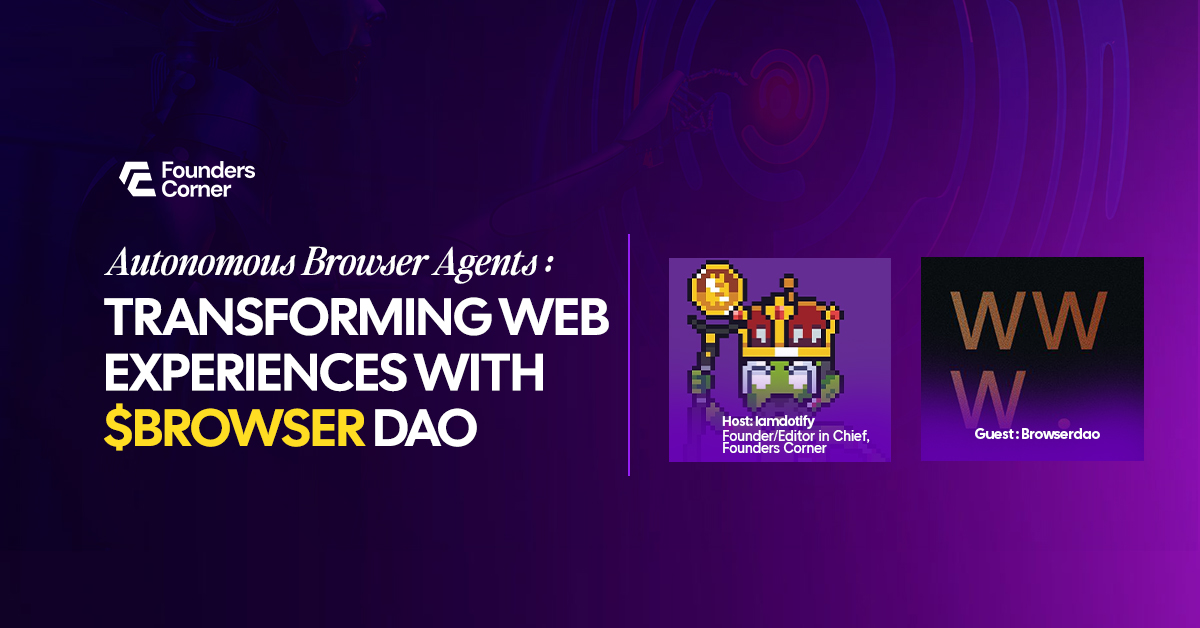
BrowserDAO can best be described as a tool that combines the intelligence of AI, like ChatGPT, with the versatility of browser capabilities. Imagine having a personal agent that doesn’t just provide instructions but actually executes tasks for you directly within a browser.
Here’s how it works: Typically when using tools like ChatGPT, you might receive a detailed guide or steps to achieve a specific objective. With BrowserDAO, you can go a step further—you can tell it, “Do this for me,” and it will open a browser in the cloud, independent of your device. This browser agent then performs the task right before your eyes. For example, you can provide a URL and specific instructions, and the agent will carry out the task in real time.
What sets BrowserDAO apart isn’t just the ability to use a browser on your behalf but how you can scale and automate these tasks. You could open multiple tabs to run various tasks simultaneously or create custom workflows to automate recurring activities. This is particularly powerful in our upcoming beta release, where you’ll be able to train your agent to execute specific tasks repeatedly, monitor for specific events, or trigger actions based on schedules—like once a day, weekly, or when a particular condition is met.
In essence, BrowserDAO takes browser interactions to the next level, making it a practical and scalable tool for both personal and professional use.
Q: The litepaper describes $BROWSER as “revolutionizing how we interact with the web through decentralization, automation, and governance.” What sets your project apart from traditional browser-based AI solutions in the Web3 space?
A: Thank you for the question—it’s an excellent one, and I appreciate you taking the time to read our litepaper.
To understand what sets BrowserDAO apart, it’s important to recognize the limitations of current AI agents. Most AI solutions today rely heavily on structured data and API access, which is only as good as the quality and availability of that data. In industries like crypto, the data ecosystem is relatively advanced, with APIs offering decent accessibility. However, for rapidly evolving areas—especially emerging Web3 projects—high-quality, structured data often comes much later in their development process.
That’s where BrowserDAO changes the game. Unlike traditional AI tools that are constrained by what APIs or datasets can provide, our platform enables agents to access the broader web—including the vast majority of Web2 and Web3 that isn’t API-enabled. This opens up a whole new frontier for interaction and innovation, allowing our agents to function in parts of the web that were previously inaccessible to AI.
In addition, BrowserDAO acts as a foundational infrastructure for other AI agents. With our browser capabilities, these agents can interface with parts of the web that are outside their usual reach, enhancing their utility and functionality.
The evolution of BrowserDAO begins with the delivery of a browser-enabled AI agent, offering users a chance to experiment with and understand the technology firsthand. From there, we’re focused on integrating with tools like Eliza to expand the utility of these agents. By equipping them with our browser plug-in capabilities, they can interact more effectively with the web, unlocking new possibilities for users. Beyond these integrations, our long-term vision includes creating a web where intelligent agents operate autonomously across the internet, transforming how tasks are executed and insights are generated.
Over the next couple of years, we anticipate a significant shift where intelligent agents will make up a large majority of online interactions, whether in forums, on social media, or in other digital spaces. These agents will handle tasks, generate insights, and interact much like humans—but on an unprecedented scale. BrowserDAO lays the foundation for this future by providing the tools and infrastructure for these agents to thrive.
Ultimately, BrowserDAO isn’t just a tool; it’s an enabler for a more dynamic, intelligent, and interconnected web, creating endless possibilities for the future of AI and Web3.
View Demo: https://x.com/browserdao/status/1880784888368079006
Q: BrowserDAO claims to reduce reliance on expensive human-in-the-loop steps and offer cost-effective automation. How does BrowserDAO compare to competitors in the AI-powered browser automation space in terms of efficiency, affordability, and accessibility?
A: That’s a great question. Human-in-the-loop processes for browser-based automation typically come with significant costs. In a Web2 context, these workflows often cost around $40 per cycle. A cycle, while a bit abstract, essentially represents a complete workflow that an agent executes from start to finish. This cost includes setup, human intervention, communication, and structuring the process, making it both expensive and labor-intensive.
BrowserDAO fundamentally transforms this space, much like other AI-driven innovations. By replacing human dependency in these workflows with AI, we drastically lower the cost barrier. Tasks that were once too expensive or impractical to automate are now accessible. For example, where traditional solutions might cost $40 per cycle, BrowserDAO reduces this to as little as 15 cents. That’s a massive shift—from $40 down to just a fraction of a dollar. With potential adoption of other cheaper models like DeepSeek, we can reduce costs even further. We want BrowserDAO to adapt and keep up with the rapid progress of AI.
When it comes to efficiency, there are natural trade-offs between human-in-the-loop systems and AI. Our basic model currently scores about 53% on the Web Voyager benchmarks, a standard measure of how effectively agents perform browser-based tasks. While this figure is lower than efficiency in the 70% range typically achieved by human users, it’s important to understand what this means in practice. The basic model excels at tasks like filling out forms and navigating straightforward interfaces—things that are both effective and inexpensive to automate.
For more complex tasks—like navigating deeply layered sites or handling intricate workflows—our advanced model performs significantly better. It achieves around 87% on the same benchmarks, coming close to human efficiency while remaining fully autonomous and far more cost-effective. This advanced model, which will roll out after the beta phase, is part of our broader tokenomics system. Token holders with larger stakes benefit not only from immediate access to the advanced model but also from reduced usage costs, further incentivizing participation in the ecosystem.
While the beta launch will focus on the basic model to monitor costs and gather user feedback, the advanced model will follow, offering a more robust solution for handling complex tasks. This two-tiered approach ensures that we provide both accessibility and scalability while maintaining affordability.
As for comparisons to other AI tools, it’s important to note that efficiency depends on the specific use case. BrowserDAO is purpose-built for browser interfacing and automation, tackling a significant portion of the web that other agents struggle to handle. If there are specific competitors or agents you’d like to compare, I’d be happy to dive deeper, but I’d hesitate to generalize across all tools given the diversity in capabilities and use cases.
Q: How does leveraging Solana enhance $BROWSER’s functionality, and what are the challenges of integrating with this blockchain?
A: Leveraging Solana is a strategic choice due to its scalability, speed, and ecosystem that naturally fosters interoperability. Unlike Web2, where systems are siloed and integration requires opt-ins or middleware, Solana’s infrastructure is inherently interconnected. This makes it ideal for building and deploying AI agents that can interact seamlessly within the ecosystem. Additionally, Solana’s low transaction costs and rapid settlement times align perfectly with the cost-effective automation $BROWSER offers, especially when compared to traditional human-in-the-loop workflows.
Another key advantage is Solana’s support for DeFi mechanisms. The $BROWSER tokenomics leverage features like staking, which allows users to earn trade fees and reduce usage costs. Token burning further introduces deflationary mechanisms, enhancing long-term value. For users, holding and staking $BROWSER tokens not only grants more affordable access to the tool but also integrates them into the broader Solana DeFi ecosystem, creating a mutually reinforcing cycle of utility and value.
However, integrating with Solana is not without challenges. The transparency and permanence of on-chain operations demand rigorous testing and auditing of smart contracts. Any flaw in a deployed contract can lead to exploits, and unlike Web2 systems, there’s no centralized safety net or insurance to mitigate losses. This necessitates a cautious and methodical approach to development, prioritizing safety over speed.
Additionally, navigating Solana’s fast-evolving landscape means staying adaptable. While the ecosystem offers immense potential, balancing innovation with security and sustainability is critical to ensure that $BROWSER remains robust and reliable as it scales.